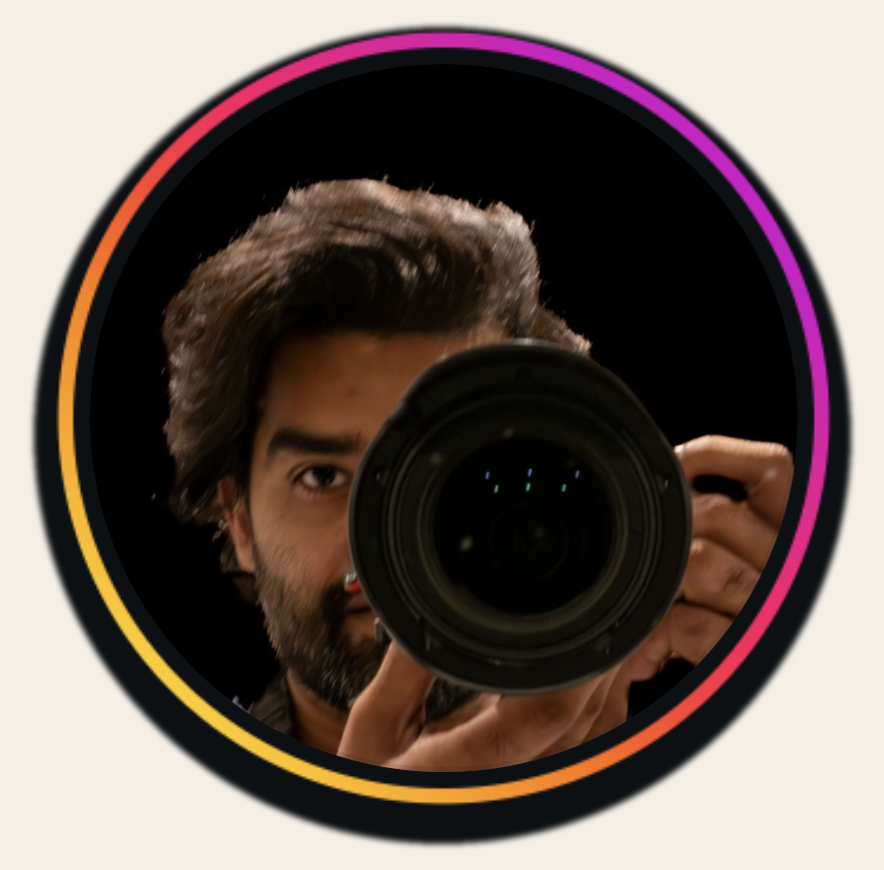
Saurav Dutta
paleobiologist & photographer · British Antarctic Survey
My photographs live in the play between realism and imagination. Every element in the frame carries its own small story; together they say what they appear to, and almost always something quieter underneath — meaning I leave for you to find rather than name.
I don't separate my subjects into genres — wildlife over here, people over there, nature as something apart. Everything is part of the same environment, and I follow what calls me to it. There's a phrase I've borrowed for this: click with your soul. Wherever the soul leads, the camera follows; the rest is trying to capture it with the heart.
What carries across all of the work is the patient observation a field scientist gives to an organism — that same attention, given to a moment. I'm interested in the emotional texture of encounter: between species, between strangers, between a person and a landscape that is changing faster than memory can hold.
Juxtaposition is one of my favourite tools — borrowed from street photography — but I'm not interested in pictures that are about juxtaposition. I want the juxtaposition itself to open onto a larger story. I'm drawn to images where the subject isn't immediately clear and what surfaces is something more abstract and more powerful: a theme I think of, half-seriously, as nothing.
In practice I work with intentional camera movement, blur, and shifts of perspective — tools to slow the eye down and let the second story arrive.
"the patient observation a field scientist gives to an organism, I give to a moment."
— before the camera
I came to all of this through Steve Irwin. Watching him as a child sent me into science, and from there into a decade of research as a seasoned field scientist — across the Red Sea, the Thar desert, the jungles of Mysore and Arunachal Pradesh; through cities including Kolkata, Delhi, Pune, Oxford, London, and Brighton; and onward to fossil shells and sediment cores in Antarctica. Currently I work at the British Antarctic Survey.
In every one of those environments I found myself reaching for a camera before a notebook. The instinct underneath the science has always been the same: tell people what's there. I now know that the voice for that work, for me, is photography. The fieldwork is what taught me how to look slowly enough to find it.
— now
Based in the UK. Available for commissions, editorial assignments, exhibitions, and collaborative projects. I work on long-form photographic series and a small number of signed, limited-edition prints — photographs marked with the ⓟ symbol across the site are available to buy.
— kit
Currently shooting on a Sony α7C with the Sigma 24–70 mm; Sony 70–200, sometimes with a Canon 1.4× converter; and a Sony 200–600 mm for the long stuff. iPhone 15 Pro Max for everything else. Started out on a Canon 1000D with the kit lens.